
The list of unanswered questions includes the price of nuclear electricity, the sources of multi-billion investment, even the full list of partners in the project, and many more.
Only recently, after the Government initialed a concession agreement (on supplying certain public services) with Japanese company Hitachi, has there been some more public debate. Loudest voices, unfortunately, are still those of quarreling politicians and not of specialist arguments.
Option of not building a plant
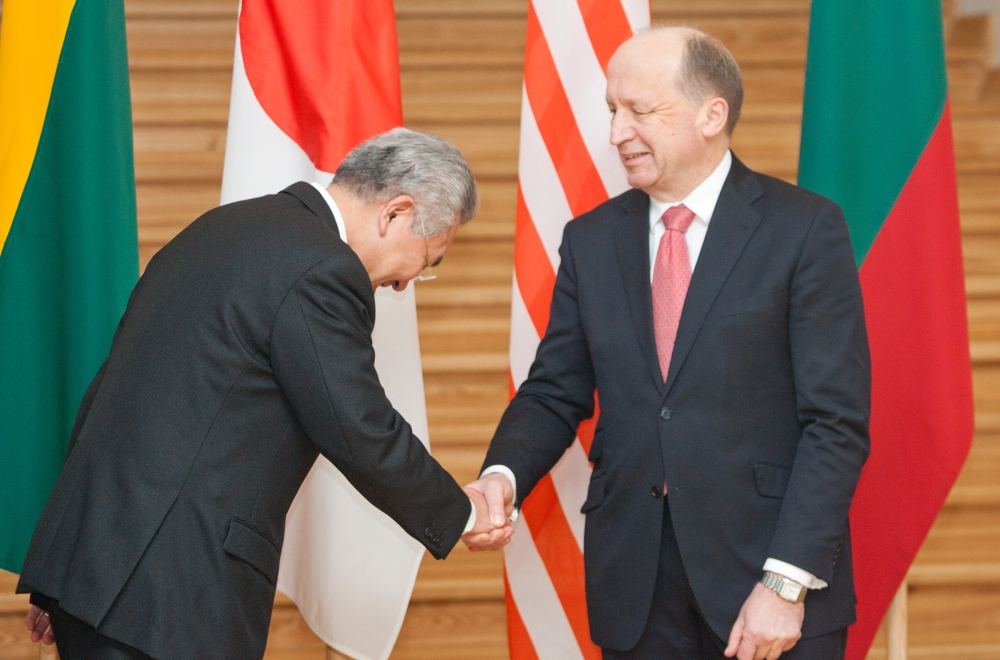
“The historic initialing of VNP concession is a road towards the cheapest electricity, cheaper even than wind power, biofuel, or burning gas,” Prime Minister Andrius Kubilius tweeted on 30 March, when Government and Hitachi representatives put their signatures on a draft agreement. He was happy that Lithuania was opening doors for its biggest ever investment that was to ensure the country's energy security and independence from Russia.
His hopes are understandable. After Lithuania closed its Ignalina Nuclear Power Plant (INP), it became the most imported-electricity-reliant country in the EU. We are currently buying 65 percent of our electricity and 80 percent of raw fuel. According to international standards, a country is considered at risk, if it imports over 10-15 percent of needed resources. We spend at least 2 billion litas (580 million euros) annually on electricity and gas used in power plants – a third of the total projected investment into the new plant.
The government assures that the society supports Lithuania's nuclear ambition. The plant's future operator has published a glossy colourful leaflet, quoting impressive figures and claims that “the society supports nuclear energy development.” 58 percent think that nuclear energy is beneficial to the country, 68 percent of students hope that VNP will create many specialist jobs, 63 percent of businesspeople and managers can see the plant being good for business, 88 percent of Visaginas residents support the project, 60 percent of scientists think that Hitachi's participation will ensure the project being finished in time, 66 percent of nearby residents (in Visaginas, Ignalina, Zarasai) support the building of the power plant. The figures are taken from last year's Spinter poll; the leaflet fails to indicate, however, who commissioned the poll.
30 preparatory projects have already been implemented, most of them having to do with various analyses (environmental impact, radiation, seismic analysis, proposed construction sites evaluation, infrastructure, etc.). However, says Linas Vainius, spokesman for environmental association Atgaja, the most important studies are still missing – for example, no one has analyzed the so-called zero option, of not building a nuclear plant at all. He is also worried that dealing with nuclear waste is not part of the project – as, it is claimed, it is an issue to be dealt with in several decades.
Billion without final agreement
The Government has already begun studying paperwork to do with VNP construction. The cabinet has to discuss the concession agreement, a business plan, the Finance Ministry's findings on financial risks, various required legislations. If the Parliament gives its blessing to the concession agreement, it should be signed by 28 June. After that, there will follow extensive work of designing the plant, anticipated to last 30 months and cost 283 million euros (980 million litas).
After that, there would be a tender to find a contractor. Only after signing a deal with the latter and agreeing with all parties on financial commitment, would it be possible to sign the final investors' agreement – no later than 31 March 2015.
Until that date, the project can be discontinued at any point, should any of the parties pull out or something unforeseen happen. In that case, Lithuania would be obliged to buy out Hitachi's and other partners' investments.
Vainius is surprised at such a timeline – the final decision on VNP will be made no sooner than 2015, after almost a billion litas have been spent oncpreparatory works – roads, etc.
According to current calculations, VNP should cost around 17 billion litas (5 billion euros), with the final price becoming known only after setting up a joint company – in three years, that is. The state pledges to provide 5-6 billion litas that will have to be borrowed. Lithuania's public debt is approaching 50 billion litas, so the figures are indeed spectacular. VPN spokespeople are quick to assure that the spending will not turn into a public debt, since half of it will be borrowed from, say, Japanese or American banks, while the rest will be financed with VPN revenues. Energy Ministry projects that annual interest on the loans should be 5 to 8 percent, if paid back over 18 years. So far, there are no guarantees that someone is giving the loans in the first place. The business plan envisages the possibility to additionally attract private companies and citizens.
According to Latvian and Estonian Prime Ministers – who are also partners in the project – we need the power plant, provided it is economically viable. Lithuania expects to hold 34 percent stake in it. Shareholders in the company implementing the project as well as their stakes will only be known in 2015, too.
So how much for electricity, after all?
The figure that the society cares most about is, as yet, also unknown. How much ordinary consumers will have to pay for electricity - during the construction of the century and after it is finished.
According to Lithuania's negotiation position, it should be 0.17 to 0.25 litas per kWh (0.07 to 0.1 litas being production costs and the rest going towards servicing loans) and decrease with time. For comparison, new gas-fueled block of Elektrėnai Power Plant produces electricity at 0.35 litas per kWh, electricity from wind turbines is bought up at the rate of 0.28-0.37 litas per kWh and from biofuel plants – 0.5 litas.
There is, however, much public skepticism about the figures. Martynas Nagevičius, director of Lithuanian Energy Consultants Association, for one, claims that electricity from the new nuclear power plant will not be competitive and will require subsidies. He suggests taking into account the fact that VNP will be built on borrowed funds that will need to be repaid with interest; besides, one must consider one's capital expenditure, reactor capacity usage rate, possible rise in construction and production costs, and money needed to build nuclear waste storage facility. According to Nagevičius' own estimates, the price of electricity produced at VPN should initially be, on average, 0.35 to 0.4 litas per kWh. Last year, Denmark's energy agency Nordpool released its market forecasts, indicating that electricity price in 2025 is expected at 0.18 litas per kWh.
Sigitas Baltuška, VNP external affairs director, says he is surprised at discussions over future electricity prices: “These debates in the media are misguided – it is misguided to talk about what electricity price will be in ten years. The market will determine the price.”
Energy Minister Arvydas Sekmokas has previously declared, optimistically, that the price of future nuclear electricity will be below the current price on the market. On the other hand, Hitachi-GE Nuclear Energy board chairman Shozo Saito was not as quick to give promises – even though nuclear energy is competitive, there are many factors bearing on its price, he ahs indicated.
Huge benefits?
Visaginas Nuclear Power Plant should be finished by 2020-2022. Its lifespan is estimated at 60 years with at least 10 more year needed for decommissioning. According to VNP spokespeople, during its time of operation, the plant should bring benefit to all taxpayers, contributing to the state budget and paying 400 million litas in dividends (that, of course, is only possible after repaying all construction loans – no sooner than 2039). The projected revenues to the state budget should be 5 billion litas. At current prices, VNP is promised to contribute 30 billion litas to Lithuania's GDP.
Last year, however, VNP head Rimantas Vaitkus admitted that the plant would be losing money. Electricity will be given to the plant's shareholders, according to pre-agreed proportions, at cost and they will be free to do with it whatever they want - use it up themselves or sell it to third parties.
According to Baltuška, the project will bring at least 11 billion litas of direct foreign investment. Prime Minister Kubilius promised that during the construction phase alone, local businesses could expect contracts worth over 4 billion litas. This should create up to 6 thousand additional jobs in the region.
Bulgarians refuse risks
Just like Lithuania, Bulgaria has closed down a Soviet-era nuclear power plant and was going to build a new one. After calculating their finances, Bulgarians, however, gave up their nuclear plans.
According to Prime Minister Boik Borisov, the country cannot afford the joint Bulgarian-Russian project and to put the burden of repaying loans on future generations. According to HSBC calculations, the final project cost could well double initial estimates – rise from 4 billion euros to at least 10 billion.


