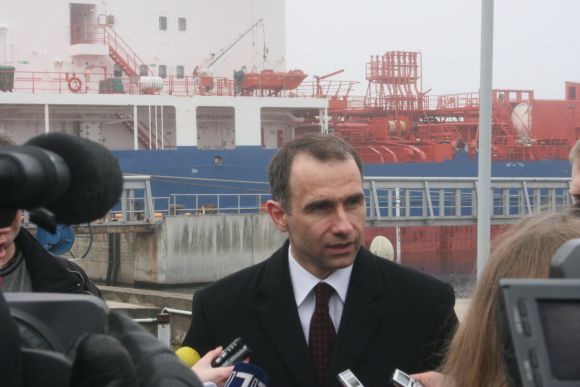
"If the countries reached an agreement, we believe that the terminal could operate as a regional one without problem. After reinforcing the Kuršėnai pipe (increasing the diameter of the Klaipėda-Kuršėnai pipeline to 700 mm from 300 mm), we could pump 4 billion cubic meters of gas to Latvia. Another possible option would be for our vessel to go to Riga in summer. As the Gulf of Riga freezes, it would be difficult to fill that tanker in winter," Rokas Masiulis said at a news conference.
"In technical and infrastructure terms, the terminal, being located in Klaipėda, could serve our region without any problems," he said.
Latvia also has aspirations to build a regional terminal and is inviting Lithuania and Estonia to join the project. However, the two countries do not rush to accept Latvia's offer and are developing LNG terminal projects of their own.
"Our project is aimed at Lithuania, but we see that there is a possibility (of it becoming a regional terminal)," Masiulis said.
He said that Klaipėdos Nafta and Lietuvos Dujos (Lithuanian Gas) are currently discussing the possibility of increasing the throughput capacity of the transmission pipeline between Klaipėda and Kuršėnai, in northern Lithuania.
Asked if Lithuania could expect EU support if its terminal became a regional project, Masiulis said that they do not expect to receive any EU funding until 2014, but will seek financing from the EU for bunkering of other ships.
"Perhaps we will be able to apply for financial support for the bunkering business. Liquefied gas bunkering is a priority area for EU support funding, and our terminal will be the northernmost in the Baltic Sea. But this is very preliminary information," the CEO said.
It is planned that bunker vessels of up to 20,000 cubic meters could be filled with gas at the Klaipėda port and could serve smaller terminals in the Baltic Sea countries. The volume of this business could amount to around 140,000 cubic meters annually starting 2015, which would increase the terminal's use by about 10 percent.
Lithuania expects to complete the LNG terminal in Klaipėda by 2014, which would provide it with an alternative to Gazprom's gas supplies.
Latvia has called on its Baltic neighbors to build a joint terminal in Riga and seek EU assistance for it as a regional project. Experts from the European Commission are currently assessing the viability of such a project.
FSRU purchase price not disclosed at Hoegh's request
The price at which Lithuania will be able to buy a floating storage and regasification unit (FSRU) for its planned liquefied natural gas (LNG) terminal in Klaipėda in 2024 is not being made public at the request of Norway's Hoegh LNG, from which the vessel will be leased for ten years, Klaipėdos Nafta CEO has said.
"The purchase price is not being disclosed because this is what has been agreed. Hoegh asked (not to disclose it), because that could affect their other projects. We ourselves are not very willing to disclose that information either. Our consultants and market specialists have warned us that we should reveal as few facts about our project as possible," Rokas Masiulis told reporters while presenting the terminal's business plan.
The CEO reiterated that leasing the FSRU is more beneficial than buying it all at once.
He said that the lease agreement covers the project's financing costs and the vessel's operating costs, which are estimated to be around 5 million euros annually and include wages to the vessel's crew, repair services, insurance and other expenses.
Klaipėdos Nafta will be able to purchase the vessel at its residual value in 2024.
The lease of the FSRU will cost the company 189,000 US dollars daily (including VAT), or 689 million dollars over the ten years.
Under the plan, the FSRU will be moored at the so-called Kiaulės Nugara (Pig's Back), in the southern part of the Klaipėda port, and will be connected to the country's gas network via a new pipeline to be built by Lietuvos Dujos (Lithuanian Gas) between Klaipėda and Jurbarkas. The pipeline project is being 50-percent financed by Lietuvos Dujos and the rest by the state.
Loans for LNG terminal from commercial banks, NIB or EBRD
The company hopes to obtain funds for project implementation from commercial banks, the Nordic Investment Bank (NIB) or the European Bank for Reconstruction and Development (EBRD).
“We hold meetings with many different banks, including infrastructural banks and commercial banks. Commercial banks are very likely to provide financing. Infrastructural banks – these are, for example, the Nordic Investment Bank, the European Bank for Reconstruction and Development,” Masiulis said.
He would not provide more information about the banks the company was talking to. “I wouldn’t like to comment now. The entire process is ongoing right now.”
The company hoped to obtain some 300 million litas (EUR 86.9 m) from banks, i.e. the amount, which Klaipėdos Nafta would have to invest by the launch of the terminal at the end of 2014, Masiulis said adding that the issues of financing were expected to be settled with banks by the end of this year.
The LNG terminal’s business plan says that Klaipėdos Nafta could generate 510 million litas for the project from its free funds in 2012-2014 and through borrowing. The port of Klaipeda would additionally invest some 310 million litas.


