"We are asking ourselves the question of what happens if the shareholders' agreement, which is currently being discussed, is not signed at a later stage. It is absolutely obvious that further implementation of the project would then be stopped until we reach an agreement on shareholders' participation," he told Lithuanian Radio.
Kubilius added that Poland was still expected to join the project as well.
"I have spoken with the Polish prime minister in the last weeks. To my knowledge, discussions at the companies' level are intensifying, too. So we may have shareholders from the Polish side as well," he said.
If the Lithuanian parliament endorses a package of documents related to the project, a concession agreement with Japan's Hitachi on the Visaginas nuclear power plant - the country's largest-ever energy project at an estimated 16 billion to 18 billion litas (EUR 4.6-5.2 b) - is expected to be signed by 28 June at the latest.
Under the plan, Hitachi, the strategic investor, should own 20 percent of shares in the plant and Lithuania should hold 38 percent. Latvia and Estonia are expected to take stakes of 20 percent and 22 percent, respectively. The ownership stakes could change if Poland joined the project.
Final investment decisions are expected to be taken within the next several years, by the end of 2015. The Lithuanian government expects the new facility to be built in 2020 to 2022.
2012-06-12 14:20
Latvian and Estonian decision not to join would halt Lithuania's nuclear power plant project
If Latvia and Estonia decided not to join Lithuania's planned new nuclear power plant project, that would bring the implementation of the project to a halt, Lithuanian Prime Minister Andrius Kubilius said on Tuesday.
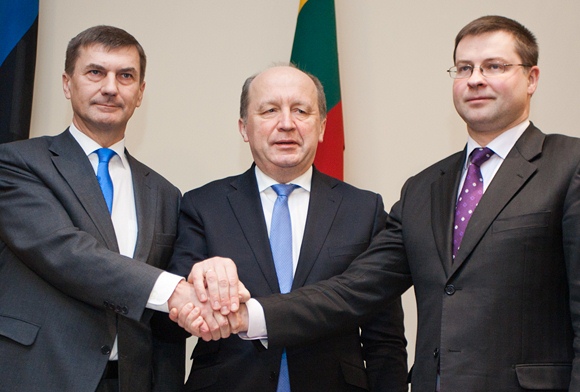
Baltic prime ministers Andrus Ansip, Andrius Kubilius, and Valdis Dombrovskis. / BFL/Tomo Lukšio nuotr.
Report mistake
Successfully sent
Thank you


