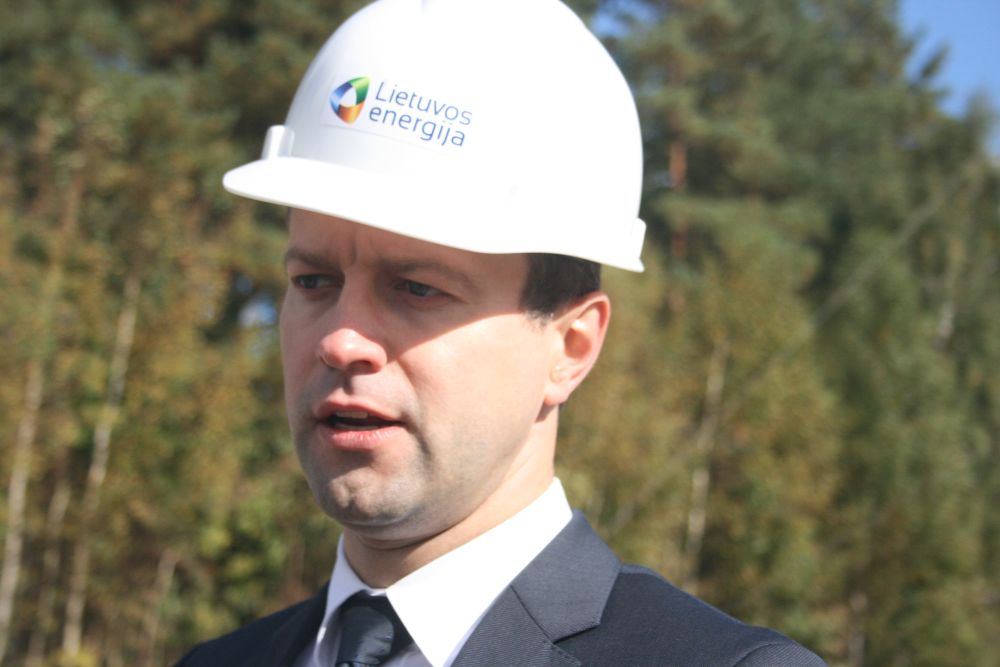
"Lithuania is on the same shale gas formation as Poland, but the Poles are at its center and we are on the periphery. Therefore, at this point, I'd be cautious in assessing the possibilities. On the other hand, if all went well and we could replace Russian gas with shale gas, we could save up to a billion litas (EUR 300m) annually. That is not including infrastructure costs. Such production does not present advantages only. A lot has to be weighed," Dalius Misiūnas said in an interview with lrytas.lt.
Lietuvos Energija's CEO said that the discovery of a new energy source always has an effect on the market, but at the moment, it is difficult to say how much impact this would have on Lithuania.
"The Poles also said they would do a lot of drilling, but all that enthusiasm cooled quickly. Exploration and extraction has not stopped completely, but they will not be able to extract as much gas as expected," he said.
Misiūnas said that Lithuania had two ways of bringing down electricity prices: building a nuclear power plant and obtaining cheaper gas.
"Unfortunately, to be able to produce competitive electricity, we would need to purchase gas around 40 percent cheaper than we do now. We could pay about 900 litas per 1,000 cubic meters of gas. Currently, we pay some 1,350 litas per 1,000 cubic meters," he said.
Misiūnas said that an LNG terminal could help reduce gas prices by 15-20 percent, noting that this market is not very well developed yet.
"This type of gas in the US is about three times cheaper than in Europe and five times cheaper than in Japan, in which demand for gas has increased sharply following nuclear power plant closures. Since most countries supply liquefied gas to Japan, we can expect, at best, European prices. That would allow us to save some 15-20 percent on gas costs, which would not be enough for us to allow produce cheap electricity," he said.


