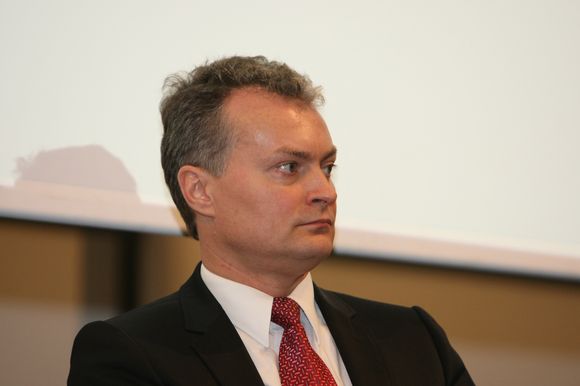
“This is the first time in 15 years that I feel so stressed and, I would say, nervous while waiting for parliamentary elections. And it is not because I am afraid of one or another political party coming to power. It’s because there are many critical mid- and long-term economic issues, which, unfortunately, cannot be solved today. Unfortunately, the uncertainty as regards the answers to these questions is very significant,” he said at the conference Economy of Lithuania 2012.
The first relevant issue was whether the authorities would maintain the priority of reducing the fiscal deficit, he said.
“I remember the beginning of 2009 when many political forces slammed the incumbent government for immersing Lithuania in debt and proposed measures that would allegedly stimulate the economy, that is, to reduce the taxes. ... the question is how these political forces would behave if they came to power, since, in my opinion, these objectives are absolutely incompatible,” the analyst said.
The second rhetorical question, in his opinion, is whether there will be any essential changes in taxation policy. The future of private pension funds was also very important, he said.
“First of all, I'm thinking of the introduction of progressive tax rates, potential increase in profit tax. The second question is the future of private pension funds. Unfortunately, the approach of certain political forces to this issue is rather contradictory, and I think that it is not necessary to nationalize them, it is possible just to put them down through the lowering of contributions, transfers,” Nausėda said.
The third question raising concerns was the progress in the construction of Visaginas Nuclear Power Plant (VAE) and implementation of other strategic energy projects. “I do hope that the energy minister and the entire energy ministry will manage to go really far before the elections so that the process could no longer be reversed or suspended."
“One more question is the policy of euro adoption in Lithuania. There is no consensus on this issue today ... but there should be a certain strategy on the euro – whether it will be the year 2014, or 2016, or it will be the policy of ‘not possible’, or some other approach. Of course, it would be good to have answers to these questions before parliamentary elections and to have them reflected in the parties’ programs,” the analyst said.
He also spoke of the budget of the social insurance fund (Sodra). “It will be necessary to get back to the essential solutions to the balancing of this budget, and it will much depend on the political deviation, which we will see in the parliament this fall”.
“Speaking of tax policy, I have reviewed the positions of the main political parties, or, to be more precise, their recent activities, and I may state that the liberal parties, which opposed raising tax burden and the destruction of the pension system on the eve of 2012, are the only ones to maintain certain ideological consistency. They stuck to their ideological position in this respect. As to the Homeland Union-Lithuanian Christian Democratic party, I see certain metamorphosis in its activities – the party was rather skeptical towards introducing progressive income tax rates in the beginning. However, it has been showing sympathy to it lately, particularly in recent months,” the analyst said.
The Social Democratic party made several proposals to introduce a system of progressive taxation during the term of the current parliament but the party actually agreed that progressive rates, if introduced now, would only be applied to income from work in the absence of general income declaration, Nausėda said.
“The approach of Labor Party and the Order and Justice Party towards tax policy is even more difficult to comment ... I would say that if those parties joined the ruling coalition, there would be many issues and surprises in tax policy,” the analyst said.
Speaking about the projections of economic growth, he stated repeatedly that SEB Bankas had been forced to lower the forecasts. The bank expected the national economy to grow by 2-3 percent this year and next, which meant that the economy would “definitely” avoid recession.
“After reaching the actual growth of nearly 6 percent we will have to move at a lower rate, of 2-3 percent growth this year and next. Let’s say it is actually not bad, particularly since many analysts project recession in the eurozone,” Nausėda said.


