
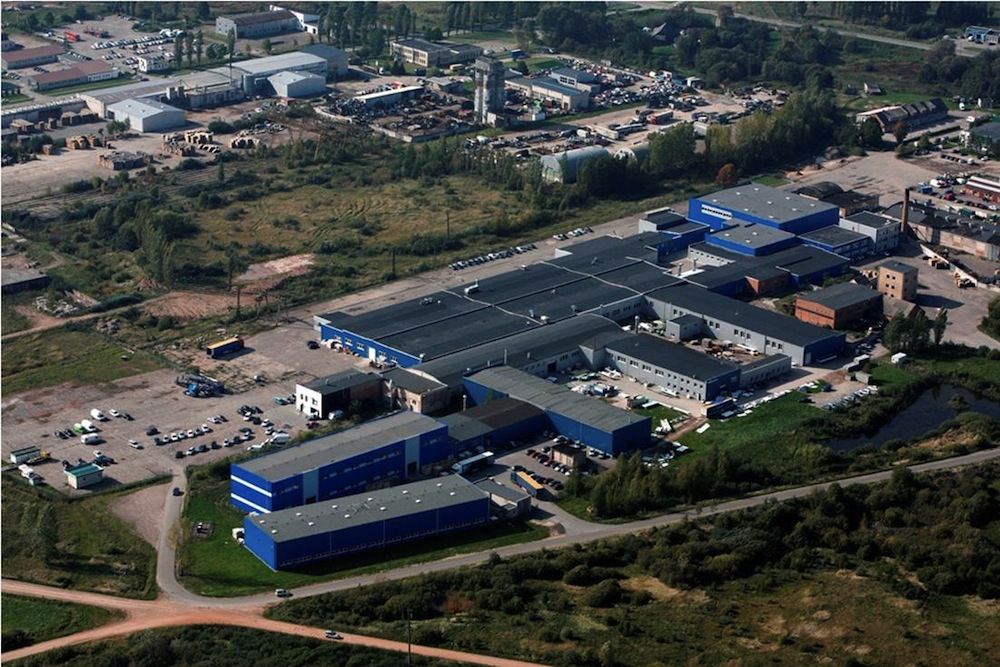
Tauragė Industrial Park, which is already in its eighth year, sprung up from the Stankai family business: Švytis, which specialised in textiles and special clothing until 2005, and Tauda, producer of motorboats and plastics.
Return home
It was Antanas Stankus who got the business going. His two sons, Darius and Linas, used to work in Vilnius but they felt inspired by father's idea and returned to their provincial home town. The businessman bought an abandoned ceramics factory to set up the industrial park. The first clients to settle there were customers of Švytis and Tauda – they rented the premises and equipment and trained their staff.
 |
| Asmeninio albumo nuotr./Darius, Linas, and Antanas Stankus |
80 million litas have been invested into the industrial park. It is to be handed additional 5 hectares of land in the near future. The clients of Tauragė Industrial Park operate in 30-thousand-square-metre premises, renovated or newly-built, and employ a workforce of about 600. The companies' turnover is expected to total 120 million litas (35 million euros) this year.
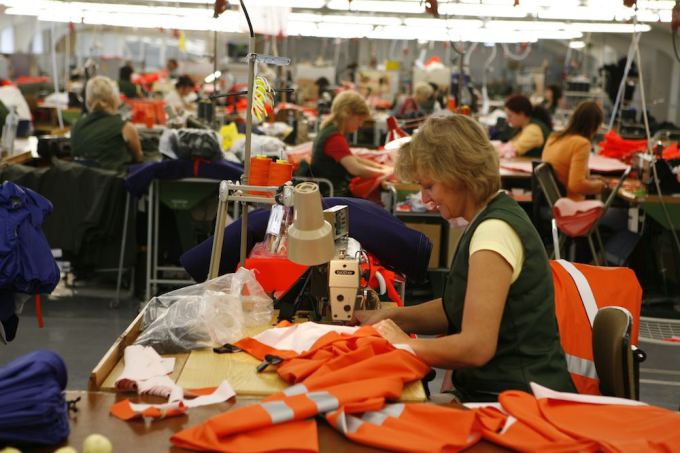
Švytis is the company that manages the industrial park and it is still making impermeable clothing. Danish-Lithuanian company Tauraplastas, which produces boxes for wind power generators, was the best-paying employer in Tauragė last year. Norwegian company Egersund Net produces industrial fishing nets.
Australian-capital company Ansell Protective Solutions Lithuania is part of an international corporation operating in 40 countries. It produces protective clothing and diving gear. In 2008, it was chosen the best company of Tauragė County Business Association (TCBA) and exporter of the year; in 2010, it was the biggest contributor to Tauragė municipal budget.
Commerce instead of factories
Tauragė in south-west of Lithuania used to be famed for its industry, but all major factories went bankrupt after the collapse of the USSR. Commerce took over – the dominating enterprises now include used car trade, supermarkets, small-scale retail, and open-air markets. Also, the industrial park, the food industry (the town houses a number of small-scale meat processing plants), makers of furniture and woodwork, car service garages.
 |
| Tauragės industrinio parko archyvo nuotr./Tauragė Industrial Park |
Darius Stankus, who is development director of the industrial park and TCBA president, believes that the biggest advantage of doing business in the province instead of big urban centres is that it allows to save time: “Most of the people here know each other, so certain decisions, even in public institutions, are made more promptly than in big cities. No time wasted in traffic jams which saves 1-2 hours each day, one can get to any place within 5 to 10 minutes by car. Banks, the registry, inspections, the municipality headquarters are all based in the town centre, so many errands can be done on foot and in several minutes or under an hour.”
The businessmen, however, are critical about the “catastrophic” way the municipal authorities look at investment. There is hardly any support to new businesses, no consulting services, bad infrastructure. The town centre alone gets the authorities' attention, they say, while no thought is given to making business environment more favourable. According to Antanas Stankus, the municipality has not prepared a single land plot suitable for business development. One wheel rim producer considered investing in Tauragė, but could not get a suitable site and relocated to Latvia.
“We have made proposals about building infrastructure in job- and tax return-intensive areas, about a fund for small and mid-scale businesses that many other towns have, about making presentations to potential investors, help for starting businesses; but it all fell on deaf ears,” Darius Stankus regrets.
Radio to bakery
Another company in Tauragė that 15min paid a visit to employs only seven people. It is now in its second year, but the owners are already thinking about expanding and even setting up a new business.
 |
| Tauragės radijo archyvo nuotr./Tauragė Radio |
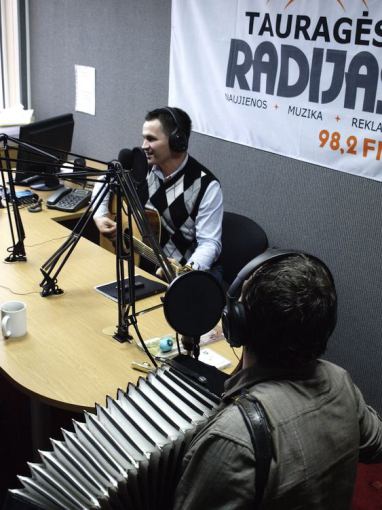
Events organizer from Kaunas Valdas Latoža together with Sigitas Kancevyčius, photographer, stage director, and head of a local public library, established Tauragė Radio Station on the outset of the recent downturn.
“If you've got a good idea, the moment of time when it strikes you is immaterial – crisis or no crisis. You've got a vision, an action plan, and you can decide whether to lay low until better times come,” Latoža says.
Tauragė County was the only one in Lithuania without its own radio station, so the idea of setting up one was on the two friends' minds since 2005 when there were still no signs of the bust. However, it was not until two years ago that Latoža's firm Šou Imperija could secure the radio channel.
They also needed funds for initial investment. Money came from Tauragė Credit Union in accordance with EU entrepreneurship programmes.
“No one believed we would succeed, banks were sceptical, one of them asked to pledge two apartments to get a loan, even though we had a tangible business plan, one based on consultations with colleagues from other regional radio stations and not rosy-eyed estimates.” Latoža recounts.
The Credit Union accepted as collateral the radio equipment that the two entrepreneurs bought for the 70-thousand-litas loan they secured. The contract requires that they commit at least ten percent of the investment from their own funds, but investors provided twice as much.
According to the project submitted to the EU, the radio station was to employ a staff of two and a half, but seven full-time employees already work there and two more are to join soon. Tauragė Radio, which went on air in October last year, broadcasts 24 hours a day and can be picked up well beyond Tauragė – in Jurbarkas, Pagėgiai, Šilalė, even Kelmė some 60 kilometres away. The radio plays music, boradcasts news programmes, shows on culture and sports. Over the first year, radio hosts have invited more than 500 guests. A father and a daughter host one-hour programmes on football. “The young girl knows more than I could ever hope to,” he says, humbly.
The two partners also produce their own radio ads, which sound a little idiosyncratic – so they differ from all the rest. Latoža assures there is no shortage of attention from advertisers, as local papers come out only twice a week. The competition will go down even further next year – Tauragiškių Balsas, a newspaper published since 1945, announced it was going out of business.
The two businessmen cannot confine themselves to a radio, though. They are about to open Tauragė's first bakery. Latoža still owns a company in Kaunas and keeps being involved in event organizing, yet he feels inclined to use all the advantages that life in the province has to offer: “There are supermarkets here, car trade is in full swing – the town seems firmly on its feet, full of life. If one has two arms and a modern attitude, one can get by.”


