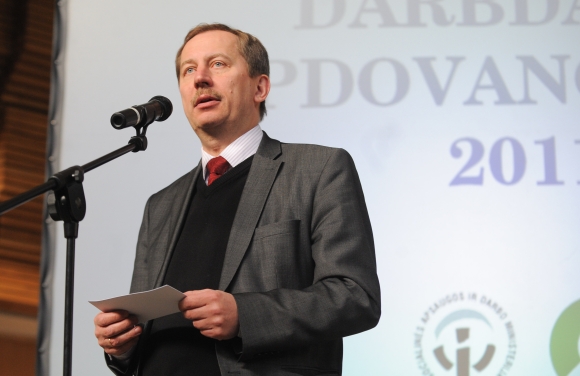
"We hope to see the winner of the tender by the end of this year," Matulionis said at a regional conference on shale gas in Vilnius.
The tender should be announced this spring, the winning company would acquire the right to explore a territory of 1,700 square kilometers at the border with Russia's Kaliningrad region and assume all risks, he added.
At the end of January, Lithuania's government gave a green light to provisions of shale gas exploration and extraction.
Lithuania is believed to have extensive resources of shale gas in an area of 1,700 square kilometers close to the Kaliningrad border in the districts of Šilutė, Tauragė, Kybartai and Kalvarija.
Minijos Nafta, a Lithuanian oil production company owned by Polish and Danish shareholders, Lotos Geonafta (formerly Geonafta), a company owned by Poland’s second-largest oil group Lotos, and US energy company Chevron are among candidates interested in extracting shale gas and other hydrocarbons in Lithuania.
Prime Minister Andrius Kubilius has said that Lithuania's recoverable shale gas reserves could be 100 billion to 120 billion cubic meters, an amount that would suffice for meeting the country's natural gas needs for some 30 to 40 years.
Market for Polish shale gas
The Baltic states could be an interesting market for Polish shale gas, which could compete with the gas supplied by Russia's Gazprom, Lithuania's Energy Minister Arvydas Sekmokas has said.
Speaking at the conference in Vilnius on Wednesday, the minister said this fact could encourage Poland to build a gas link with Lithuania.
"The Baltic states could be an interesting market. Looking at the prices of shale gas in the United States, shale gas extracted in Poland could be alternative to Gazprom's gas," Sekmokas told BNS during a break in the conference.
Poland expects to start commercial extraction of shale gas in 2014. According to calculations by experts, reserves of shale gas in the country would cover the country's needs for 300 years.
Lithuania and Poland are planning to start building a gas pipeline within four years. The aim is to connect the Baltic states with the market of the rest of the European Union (EU).
Currently, Lithuania buys all of its gas from Russia's Gazprom.
Environmental risks - Russian scam?
Lithuania's Energy Minister Arvydas Sekmokas says that argumentation of environmental effects of energy projects could be spurred by Russia, which aims to keep its monopoly in Lithuania.
Speaking at a conference in Vilnius on shale gas, he was answering questions about public opinion about potential extraction of shale gas, which has come under criticism worldwide for its environmental effects.
European countries do not have a common opinion on shale gas, which is a substantially growing industry in the United States. Critics maintain that splitting rocks to get gas may affect the environment.
"Very often just environmental and energy issues are being used politically in order to prevent objectives of market creation," Sekmokas said.
"Lithuania is anually paying probably more than one billion euros to our Eastern neighbour for energy resources. And, of course, there are big efforts to maintain this currency stream in the same way," the Minister added.
In his opinion, the Lithuanian public knows very little about possible environmental impact by shale gas extraction
Sekmokas expressed certitude that the international conference held by Lithuanian ministries of Foreign Affairs and Energy in cooperation with the US Embassy in Vilnius on Wednesday “will bring much more light and we can talk about facts and not speculations that are being brought forward very often."
"When projects like shale gas, new nuclear power plant, LNG will be implemented, these currency flows to the East will diminish or disappear altogether. It will bring much more opportunities for the local economy, local people, for employment here in Lithuania," the minister added.
"So I think very often these issues are raised to compromise our efforts to achieve energy independence, to achieve security of supply and to create an energy market. Monopolists are trying to maintain their position and for that, they are using all means, including the media," Sekmokas said.


