Last weekend, a biker event marked beginning of the summer season. Local authorities reasoned: let's throw a few more events, a concert and we'll have a beginning-of-summer festival, at least for the bikers, at minimum expense. But after the weekend, the resort went back to its slumber. Šventoji is not expecting visitors at least until St John's (24 June) – as testified by closed shutters at cafés and kiosks, heavy locks on wooden cabins.
Empty town
 |
| Jurgitos Andriejauskaitės / 15min.lt nuotr./Season preparations are still slow |
Šventoji, which is only 10 kilometres away from life-bustling Palanga, has a resident population of 1,800 – no more than a rural village. On weekdays, only one or two people pass the town's central street; a sound of hammering might echo from further away or a whiff of fresh paint. Only a few cafés have opened yet, but even they are near-empty.
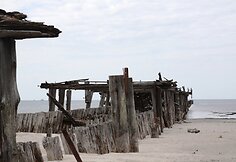
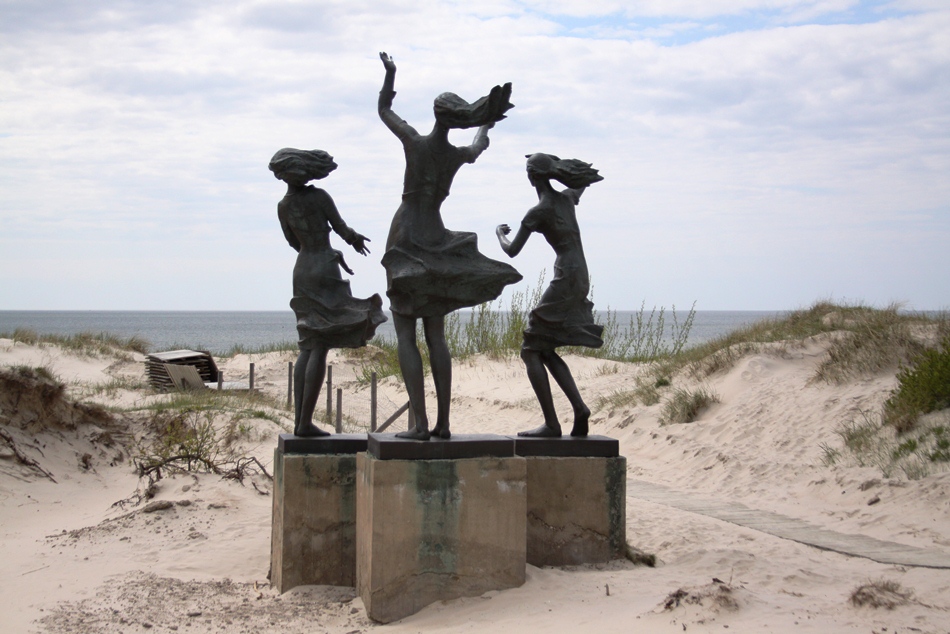
The beach is also deserted – the sole human figures are those of the Three Sisters – a group of statues that have come to symbolize the town. Now, however, the sisters are no longer standing on top of a hill – they have hidden themselves behind sand dunes, as wind keeps pushing sand to the shore.
“We have impressive dunes. We are fighting the sand, while in Palanga, (the sea washes it away and) they have to bring it in. But waves keep taking it here, we have nowhere it put it,” Eugenijus Čilinskas, Šventoji town elder, smiles.
Town is not waiting for guests
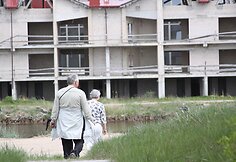
There are several novelties in Šventoji this season – a petrol station just outside the town and a new 100-room hotel “Energetikas” will open in June. The rest, however, is the same: shabby wooden cabins and unfinished construction sites.
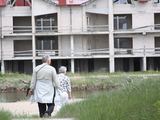 |
| Jurgitos Andriejauskaitės / 15min.lt nuotr./Lone holidaymakers |
The residents of Šventoji – just like in Palanga or Nida – make their living from tourists. But they make no haste.
Two men were fixing up a kiosk that would be selling smoked fish or perhaps even meat. “I'm helping out my brother, he had just bought the kiosk, it will be his first season. We ourselves smoke fish in Kintai, take it to Vilnius, we're doing well there. We'll see how it goes here, there are plenty of people in summer,” said one of the men from Plungė.
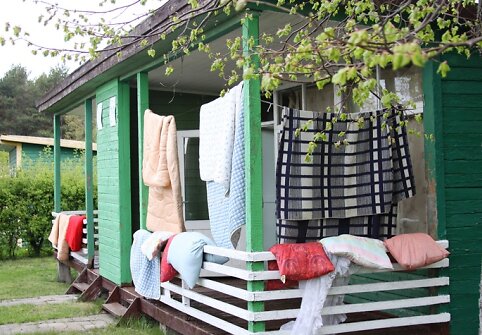
Judita, who rents out cabins for holidaymakers, said she did not have any bookings for the festive opening weekend. She and her family had started preparing the cabins merely days before. She is renting the 40 wooden houses from state-run company Lietuvos energija (Lithuanian Energy).
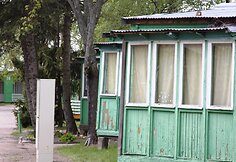
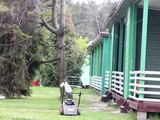
“Šventoji starts preparations later, our season does not start before St. John's. We clean windows, dust, air beddings, take out trash, mown lawns. These cabins are pretty run-down, they are 30-40 years old. We repainted them last year but what's the use? Paint peals off over winter. Wooden planks are going off, but the location is picturesque, under lime trees, much space for children to play,” Judita told 15min. “I'm not sure it will be worth renovating the cabins in the future, I'll have to tear them down. There are modern privately-owned cabins, they have water supply. Here, people have to go to showers all the way over there.”
Tax for the poor
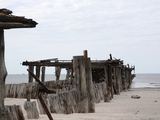 |
| Jurgitos Andriejauskaitės / 15min.lt nuotr./Šventoji |
Last year, the woman had to upkeep the cabins on her own. She says there are no money to hire help, as holidaymakers usually come for weekends only, unless the weather is good. Summer season lasts for merely two months – during which hosts must earn enough money to last through winter.
A three-bed cabin costs 50 litas (15 euros). Judita thinks that it is the only opportunity for people of more limited means to come to the sea.
“I'm furious about the new so-called “pillow tax” – one litas per person. Irrespective of whether someone hires a 400-litas luxury suite, or a poor soul stays in a cabin like this – all pay one litas. I'm mad they don't differentiate. No one pays any attention to Šventoji – that one litas will probably end up in Palanga. Look at the town's image – no benches to sit down , street lamps look like highway lighting. They don't budget for beauty, give no though to people over here. Except planting a flowerbed every once in a while,” the Šventoji resident sulks.
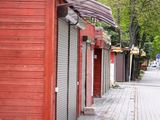 |
| Jurgitos Andriejauskaitės / 15min.lt nuotr./Kiosks are still closed |
Kiosks springing up
The elder of Šventoji makes no secret of the fact that the resort is not the way he would like it to be. Šventoji is like an orphan, even though it is part of Palanga municipality which administers the town. It forms a separate administrative eldership.
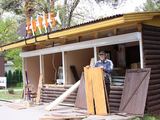 |
| Jurgitos Andriejauskaitės / 15min.lt nuotr./A kioks that will be selling smoked fish |
“We feel like orphans – residents here pay the same taxes as in Palanga, but infrastructure is markedly worse. It doesn't take to look far to see the difference – everyone can see it with their bare eyes, except our politicians. And it should be one pretty resort,” Čilinskas says.
The elder of Šventoji knows everything that happens in his town. He says that some businesspeople started preparations for the season during the clean-up campaign “Let's do it” (in April). “All spring they've been taking old beds to waste containers. They must have thrown three hundred of them away. That means they are touching up, making improvements,” he says.
Wooden cabins – there are around one thousand of them in Šventoji – is not a problem, he thinks. With time, some buildings will crack and be removed. A much more serious problem is one presented by kiosks that have been ousted from Palanga and now reappear in Šventoji.
“They are growing on us! In insane numbers – and 15-20 new ones spring up each year. I've counted over 110 of them in two streets. As I see it, if there's a stationary sales outlet – say, a café – then a kiosk nearby is highly inappropriate. Every three metres – “chiburekki,” “lavash,” and other smells mixing together. As if you're walking in a marketplace,” Čilinskas fumes.
Much as the elder resents kiosks, he cannot do much about them, as most are located on private land.
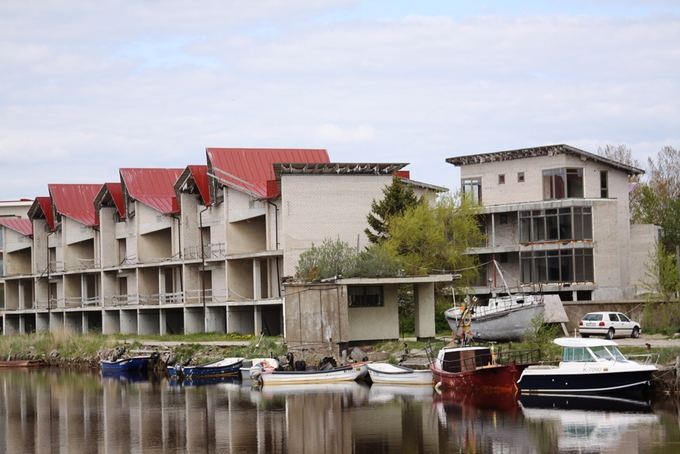
The harbour detective story
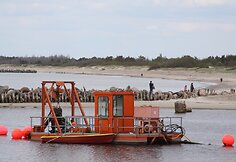
Šventoji was supposed to get a new point of attraction – a small harbour suitable for yachts. However, a series of misfortunes befell the project. The harbour should have opened last year, but Latvian company BGS that was paid to do the dredging did it incompetently and sand soon reaccumulated on the seabed.
This year, it was Kretinga district company Alvetos Karjerai that won the contract. But dredging works have been dragging hopelessly late from the start. According to the contract terms, the company must dig up 30 thousand cubic metres of gravel by 1 June – but it is already evident it will not be able to finish the task in time.
“The situation is even worse than last year. The previous company simply made a mistake. The current contractor does nothing but mistakes,” says Eugenijus Gentvilas, head of Klaipėda National Sea Port. Suspecting that representatives of Alvetos Karjerai might have forged an insurance policy, he has even gone to the law enforcement.
 |
| Jurgitos Andriejauskaitės / 15min.lt nuotr./The harbour of Šventoji |