
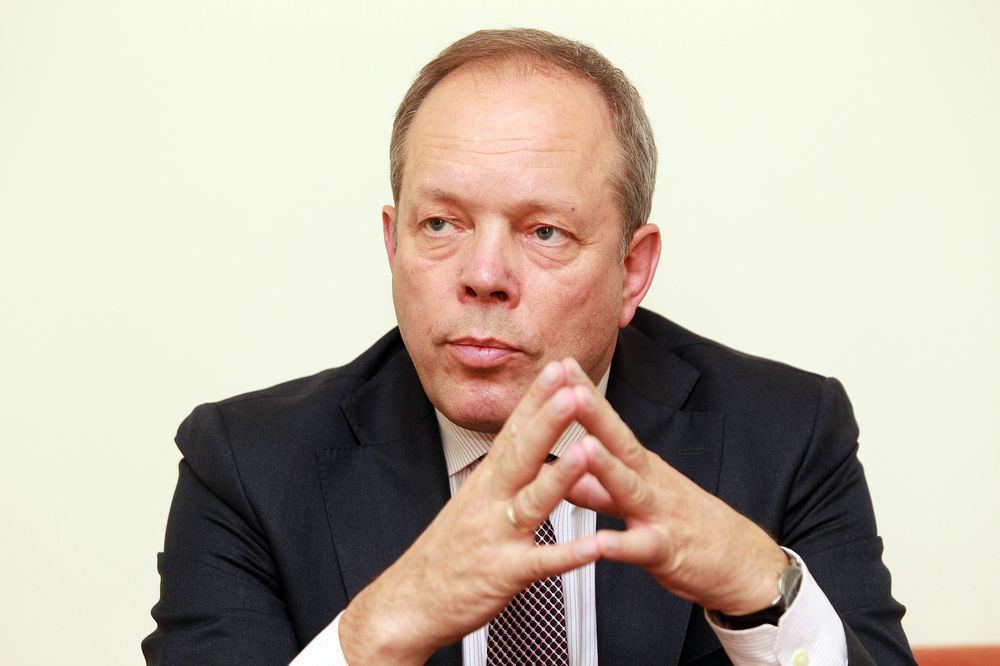
In an interview to 15min, he admits that the project of building a new nuclear power plant could have been started while the old one, Ignalina plant, was still operational. Besides, he adds, the new plant will not be a cure-all – Lithuania will still have to get almost 40 percent of its electricity from other sources.
- Even though we might be late, but why are we rushing to build a new plant, even though we've still got a complicated and expensive problem – decommissioning of Ignalina Nuclear Power Plant?
- We are late indeed. 12 years ago, when I was deputy minister, I had this vision: we were committed to shut down Ignalina Plant in 2009, so I was hoping to start preparatory work for a new block, so we could move everything from an operational plant. This, unfortunately, did not come through and we are now behind with the process because preparations were started late.
If a country's energy sector is like a sandwich, then nuclear energy will be Lithuania's bread and other sources - including renewable energy - will make for a topping, says Vaitkus.
The decommissioning of Ignalina Plant will take long. If we wait until it is over, it will be year 2030. That would be irrational. We currently import 80 percent of our electricity, 93 percent last Monday. The situation is abnormal. We must be the world's record-breaker – the country importing the biggest share of electricity.
- Has anyone considered an energy strategy that would not involve a nuclear plant?
- Of course, options of both gas and coal as well as all-renewable sources were considered.
There isn't a single country in the world that relies entirely on renewable sources. According to energy system that has been developed until now, the basic electricity generation is done by steadily-running plants.
After analysing all alternatives and bearing in mind that we are dependent on one country as a source, Russia, in order to diversify our energy generation, nuclear energy was chose as the most optimal option that would distribute pieces of our energy pie more rationally and securely.
- If the concession agreement is terminate in preparatory stages, Lithuania will be liable to pay 700 million litas in compensation for the project partners. So we are to carry a heavy financial burden in any event.
- We won't have to pay anything, if the project is interrupted for no fault of our own or if one of the parties pulls out. That would happen if the state changed essential conditions.
Serious work must be preceded by serious thought. There were negotiations, the project was put together, the laws passed, alternative options assessed. All of our strategies included developing nuclear energy. All the key laws – Nuclear Energy Law, Nuclear Power Plant Law, Energy Strategy – were pointing towards a nuclear power plant. We are now beginning to analyse the project conditions in more detail.
Preparing a project is indeed an expensive task. All parties are well aware of that. But if, as we put together a project and make key decisions, we involve other countries as shareholders and investors – so if we fail to meet their expectations, we have to pay. This is normal business practice. No contract fails to include an exit clause, conditions for divorce.
- Where will the new plant be buying uranium?
- We can buy uranium from all the countries that mine it. We also have a wide choice of where to produce fuel. A nuclear fuel contract is a separate one and it leaves us much room for manoeuvre.
- Russia also makes to this list?
- Kazakhstan would be more likely.
- Champions of the power plant quote independence from Russian energy and raw materials. But the opposite might happen – won't we become even more dependent on Russians, if we end up buying uranium from them?
- Fifteen countries mine uranium, it is enriched in many plants on all continents. I very much doubt the Japanese or Americans will take uranium from Russia. They didn't need to until now. Unless it is much cheaper. But it is an international project and all shareholders will have a say in the decision.
- Robertas Dargis, a prominent businessman, thinks that energy independence could be ensured without a new nuclear power plant. We could integrate ourselves into the European energy system, we could strengthen our links to Finland, use the capacity of Kruonis Pumped Storage Plant, build a liquefied natural gas terminal.
- I know what Dargis thinks of using Kruonis Plant to full capacity. But it does not generate electricity, it stores it. Its output loss is 30 percent. If we managed to get the cheapest electricity, and a lot of it, perhaps it could be viable. We are already using Kruonis Plant well enough, whenever we have cheap energy. But it cannot be the basic source of electricity. The model is highly unsustainable.
We are considering building one more dynamic generator, so we can accumulate excess wind power. But today, wind power rate is 0.3 litas (per kWh), so electricity thus produced would cost around 0.45 litas. It is not sensible from the economic point of view.
If you can produce a thing that you need, you must do it. There are always things to buy in the market. But if we stop producing, we will soon have nothing to live on. Electricity is one of the basic commodities, you cannot live without it.
And we knew and still know how to make electricity. We now pay 2 billion litas a year for electricity we buy. If we built a nuclear power plant, the money would stay in Lithuania. That would be one of the easiest ways to economic recovery.
At the same time, we must develop alternatives – use biomass more effectively, biogas. But their amounts are insufficient. To generate 500 MW power – such will be Lithuania's share in the nuclear plant – one needs 4 million tons of forest. Just imagine that amount of wood! 1 kilogram of uranium equals 50 tons of wood. It is an important economic factor, if one can grow bread oneself and at a good price, even if it costs a little more.
- The greens are convinced that, quite on the contrary, the nuclear plant will suffocate renewable energy development and will not encourage to economize.
- The new Energy Strategy envisages developing wind power. On the other hand, that would require much extra investment into infrastructure. One must not forget that it's a regional power plant, our share will be 38 percent. By no means will it choke alternative sources, since even after we build Visaginas Plant, we will still need to import 35-40 percent of electricity. This amount might well be produced by other sources in Lithuania.
- The Prime Minister claims that building the plant is the easiest way to get the cheapest energy. How much will it cost? Shouldn't this figure be the starting point of all considerations of energy future?
- Price is certainly not the point to start. Shareholders calculate the return on their investment. This is how we assessed the economy of the entire project. The current choice wouldn't have been made otherwise.
Hitachi is a giant corporation, its annual turnover tops 100 billion US dollars. We have the opportunity to borrow with the support of Japanese and US Governments. Everyone understands – if the project does not make economic sense, shareholders will not invest.
An important factor is that we already have infrastructure for the project. We can fully use the former plant's infrastructure. Building a nuclear plant on plain field would involve immense infrastructural investment. So our proposal is attractive.
It's a thankless task to talk about prices as they will be in ten years. How much will petrol, bread, other essentials cost? There are trends, analysts make their calculations. We have data that the price in the region should fall within 50 to 70 euros per MWh – which translates into 0.17 to 0.25 litas per kWh. We can see that, with such price levels, our project is competitive.
If we distribute the average price – even its lowest estimate – it will cover 10 percent of capital return over the entire exploitation period. For projects of comparable importance, this is a very good indicator.
- You have once compared energy to a sandwich: nuclear plant is the bread, while renewable energy is butter, ham, cheese, and salad. Why does the breed need to be radioactive?
- The base – which ensures the stable functioning of the entire system – is our bread, while we can put various extra things on top. Our water resources could provide for no more than 50 MW of power. We must necessarily upgrade thermal boiler-rooms, turn them co-generational, so they can produce energy from biomass.
Some say that we have big capacity installed in Elektrėnai (Thermal Plant). True, but it's an old and inefficient plant. It's a veritable crime to build one like that. Every kWh of energy costs a lot, its price is above market value. We must talk of competitive power generation, otherwise there's no sense in turning on any power plant.
The bread will not be radioactive. Today, it's the safest technology available. If we do not believe in technology, we will end up living in stone age, burning fire, nothing else.
The disaster in Japan has shown how weak a man is when facing nature. But the disaster struck a plant that was 50 years old. Modern nuclear plants are incomparably better than those from back then. It is like comparing a wood-fuelled car with modern vehicles. The technology has changed dramatically.
Ours will be a tested reactor, there are already six like that in the world. It won't be the first, experimental reactor of its kind. It has top security indicators. Theoretically, there might be better ones, but none has been actually built yet.
- The Government resents an initiative by some MPs to hold a referendum on the new nuclear power plant project. Wouldn't it be advisable to check with the society?
- I am all for checking with the society, provided it is done in time and it is what people themselves truly want.
I'm implementing the Government policy, I run a state-owned company. There are laws in place that allow us, even oblige, to develop the project.
Those same MPs who passed the laws now say: Wait a minute, let's check with the people. What were they thinking when they ordered the Government to develop this project? It was really strange to hear about this initiative of several MPs. To be consistent, they should now cancel the laws and assume responsibility for money we've already put into this. We might have to refund huge investments made by Hitachi, by Latvians and Estonians.
This is hard to imagine. I think that MPs must take responsibility for their own decisions and not go to the people asking what to do now.
- According to calculations, the construction of the plant should create 6 thousand new jobs in the region. Who is going to take them? Won't the investor bring in most of the workers?
- During peak periods of such constructions, around 6 thousand people are employed. Slightly fewer in Japan. But we can hardly expect the same ratio of quality and professionalism. The Japanese expect they will need the same number of workers. Local businesses can claim about 30 percent of the projects that are being implement outside the country of the origin of technology – Japan in this case. That includes general construction work: designing, engineering. Transportation companies and developers will get most work.
I'd suggest them to consolidate, to join forces, as the extent of works will be outside of any one company's capacities. Their job is to meet qualification criteria. We will hold a competition for selecting contractors. We want to get the best price. It would be difficult to ensure that only Lithuanian companies took part in it. Doubtlessly, they have certain advantages – their workers are local, it is always more expensive to bring people from elsewhere.
During the exploitation period, the nuclear power plant will employ around 800 people. Other tasks – transportation, servicing – will require ten times as much. While Ignalina Nuclear Power Plant was running, it provided work for the entire town. Construction is a great boost to local economy.
We envisage there will work no more than 400 people from Japan during the construction. Our aim is to build a company from scratch. We want to train specialists and hire those who have experience.
There are many people with experience in this sector, many Lithuanians who now live abroad, including in Japan and America. I think they'll bee tempted to come back and work here.
We will also need many managers that can be trained here. The longest training period is for reactor operator and control panel staff – people who run the entire process. Other jobs, on the other hand, are not unique. We might need help from foreign professionals at first, but I don't think many foreigners will want to come here.


