
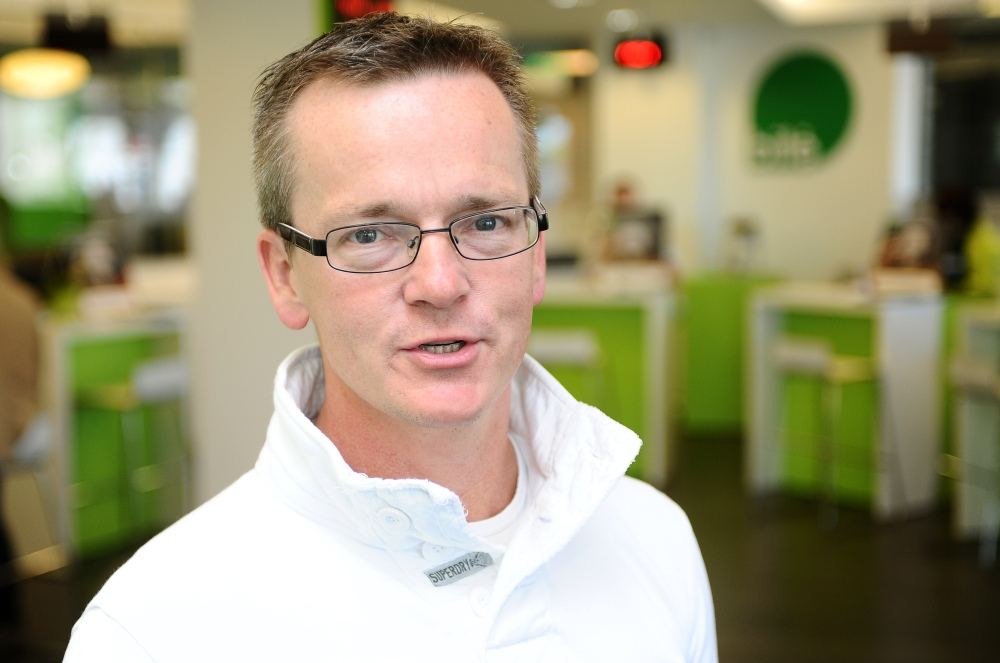
“A good leader shouldn't shun from hiring employees smarter than himself. But, following this logic, the company head must end up being the dumbest employee,” Robbins explains.
He joined Bitė Group two years ago and could choose between an appointment in Vilnius and in Riga. Robbins chose the Lithuanian capital and says he does not regret it: beautiful environment, pleasant people, while climate is very much like the one in his native Canada. All that is missing is a mountain range.
One of the downside of living in Lithuania is the devilishly complicated language. Robbins studies it on his own, dedicating one hour each day. “I can read a sentence and understand the radical of most words, but what the whole word mash means is beyond me. All those endings, collocations, conjugation. How do you make head or tail of it?” the Canadian laughs.
Therefore, while discussing business, he always uses English. To avoid misunderstanding: “Any Lithuanian speaks English better than I speak Lithuanian.”
Talking business, in English or not, does come easy to Robbins – he has convincing answers to all questions, like why Bitė still has the smallest 3G network in Lithuania or what to do with the company's multi-million debt.
- Lithuanians have long accustomed to see Bitė as the “middle” operator between the highest quality and lowest price. Where do you see the company's place in Lithuanian telecommunications market?
- Of course, one must have good price and quality, but in Lithuania, all operators are gradually converging. That is, our prices are essentially the same, coverage is the same, and quality is equal. So in a way, there is no position “in the middle.” There are no more compromises – one must provide top quality at best price. Our main focus and added value is customer service.
- Your rivals have recently launched a new price war and Bitė joined it. Who is getting anything good out of these price wars?
- The answer is simple – clients. And, of course, if the client is happy, so is the service provider.
But essentially the prices in the sector have been falling for the last five years. Prices in Lithuania are currently lower than anywhere in Europe, so there's not much room for further decrease. If we looked back at last year, prices have essentially stabilized, even in pre-paid services.
So I do not see actions by our competitors as short-term. And, to be honest, they do seem desperate.
All this is merely competition, everyday occurrence in business. And we must set prices that are competitive.
- According to a recently-published mobile networks review by the Communications Regulatory Authority, Bitė's 3G network coverage is only 9.6 percent (Omnitel's is 74.2 percent, Tele2 – 63 percent). Is this accurate? Does that mean you are not investing into network development?
I don't care who has the biggest network. And we are not seeking to build a network coinciding with that of our competitors. We are building a network that our clients need.
- Of course, those maps are accurate. But I don't care for them. We look at how and where our clients use mobile services and we are develop the network based on that. So the map reflects where our clients need 3G services and where they use it most busily.
We carry out regular client polls, paying particular attention to network quality. Quality assessments of our network has improved over the last nine months, while those of other service providers went down. So they're wasting their time and their clients' money for nothing.
I don't care who has the biggest network. And we are not seeking to build a network coinciding with that of our competitors. We are building a network that our clients need.
You know, when the report came out, we were surprised: are they really wasting money so much? We did a repeated study to make sure and it revealed that our clients are perfectly happy with our network coverage. So we don't see a problem there. I like the fact that we are not investing in vain.
Speaking of money, we have invested around 500 million litas over the last five years.
- Owner of the group, Mid Europa Partners, issued bonds back in 2007, when it purchased the company, to cover part of the takeover. You will need to repay over 190 million euros by 2014. Will you manage to do that? How does the debt affect your business and investment outlook?
- Everyone keeps asking that and it seems odd to me. To my knowledge, most companies in the world use various forms of debt financing. Google accumulated 3-billion-dollar corporate debt last year. No one has any problem with that.
The debt level puts no pressure on us. We've had it since the beginning. It's simply a way of financing business.
When we can spare some money, we buy out some of the bonds, but our goal is not to buy all of them, since that is a good way to do business. It's like an investment. We will continue to borrow in order to expand business.
As for finances, our situation was stable last year. Bearing in mind that interconnection charges have dropped 40 percent over recent years, maintaining stable revenue is a good achievement. We're also responsible about our spending, we don't invest unnecessarily.
- Bitė's withdrawal from the public procurement system of the Central Purchase Organization (CPO) – is it a well-reasoned decision or an impulsive show-off move? How will that affect Bitė financially?
- We don't do anything for PR. Our decision to leave CPO has also nothing to do with that.
The CPO's public procurement procedures make absolutely no sense. Mobile service here is cheapest in Europe. Offered services and network coverage are the same. But these procurements are only based on price.
We are focusing on client service. If they are reluctant to appreciate that – great, we are not for everyone. We wont' take part and waste our time on something that brings us nothing. We will instead focus our attention on private, small and mid-size business clients.
- What are the company's plans and goals for the nearest future?
- Firstly, we will focus entirely on client relations, on better servicing our clients. We learn each day from our demanding clients and try to improve – that's our slogan.
We've always done well in this department, but we want to excel. Our main goal is to become a company with the best customer service in Lithuania by 2014. Not only among mobile operators but among all companies.
- Will your becoming the boss of Bitė Lietuva change anything?
- I've been playing the role since last summer. My main focus was on Lithuania and I'd only occasionally visit Latvia and Estonia. And the group's head Fred Hrenchuk would take care of Latvia and Estonia, occasionally dropping by here.
So I've been essentially doing the job for the last 6 or 9 months. That won't bring much change.
The main reason behind the position change is that what we did was successful. We have 500 employees, over one million clients – it felt like we needed a CEO.
I work in this market, but even I pay no attention to what kind of network works on my phone.
I'm personally not into “titles” and I didn't want a change in position, I liked being deputy CEO for clients. But looking from the outside, it made sense that a company like that needed a chief.
So the main difference is in my title. Even my pay stayed the same.
- Let's talk about the future of telecommunications. Is it likely that calls ant text messages will be free eventually? Does the future lie in mobile internet – people getting all the services they need via applications?
- All this depends to a great extent on people's needs and behaviors, on whether they'll be willing to use applications like Skype, Blackberry Messenger, etc. I think such applications can take hold globally, but only in certain markets. Say, in the US, UK, some Asian and European markets, where mobile services are expensive – they do hold promise there. It makes sense that clients should say: “Ok, if I can get this for free and it is included into my cellular data charges, I'm in.”
In that case, mobile operators can set fixed monthly service rates. People will have to pay for access, not usage, since these applications provide for practically unlimited usage.
As for Lithuania, people will take interest in these applications much later. When mobile services are cheap, these applications are no big threat to operators, as there is little incentive for people to switch to them. I can't see a threat for at least 3 or 4 years.
I also don't think that it will make much sense for operators to lower prices, at least over the coming few years they should remain stable.
- When are 3G and smartphones getting hold in Lithuania?
- If we went back 10 years and read future forecasts from back then, it should have happened eight years ago. These things are greatly overestimated.
We see a rise in smartphone sales, they are catching up with other European countries, but interest in them came several years late, the crisis also made adjustments.
Now, as mobile internet and smartphone prices go down, the sales curve goes up. All phones on the market will be capable of processing mobile data. There won't be a separate category – we won't be talking about smartphones but simply phones.
- When are you expecting a 4G breakthrough?
- First of all, I don't think people really care about it. I work in this market, but even I pay no attention to what kind of network works on my phone. Even at home, I'm not entirely sure what internet services I'm getting. I don't concern myself with that and I don't care about speeds – I don't even know it.
How do we see it? We are monitoring what services people use in certain places – and when these services require greater speeds, we provide them.
Many of our clients who use mobile internet check emails. EDGE connection is fast enough for email. If they browse the net, this network, too, does the job. When there's a need for quicker data transfer, we build a 3G station.
As for 4G LTE, I haven't seen any applications that would require such speed – and I haven't seen any phones to handle it. Should we invest into it?
Sure, we have four sites in Kaunas for testing. We are planning to build 20 sub-stations over the coming three months, but only to test the technology, to see what speed can be attained, etc. Not for commercial purposes – that is not happening earlier than in a year.
- What share of Bitė's clients use smartphones?
- Phone sales much depend on special offers we give. At the moment, people buy Samsungs, Blackberries.
When we offer discounts, smart sales account for 40 to 50 percent of the total.
So we are approaching the European average, mostly due to dropping prices and increasing choice of devices.
In general, smartphones make up 25-30 percent in our network.
- You yourself are carrying a Blackberry. What are you using it for, besides making calls and texting?
- Of course, phone calls, texts, email (I deal with half of my mail on phone and not computer or iPad), Google, Facebook, Twitter – I use the phone with social networks, I post status updates, share photos. I also use WhatsApp and Korean Kakao Talk, many other apps.
My phone bill is always very big and that is worrying.


