
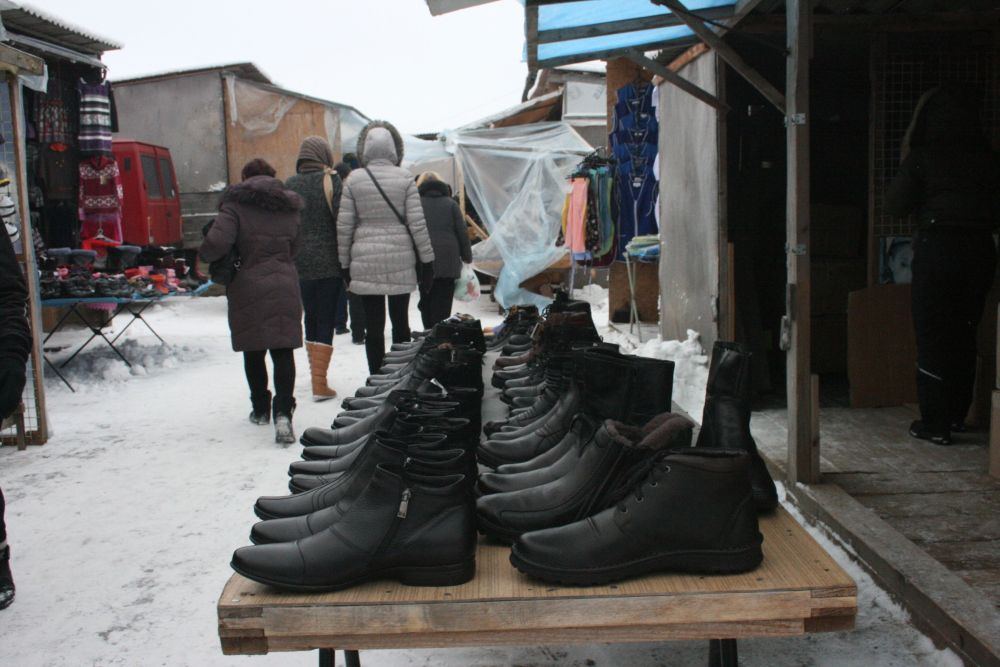
When I last visited this big open-air marketplace in 1997, the view was pretty much the same it is now: some traders display their merchandise on folding tables, others trade in cellophane-covered tents. Others settle in metal garages.
Rietavas Market has changed little over the twenty years of its existence. Yet it swam through the economic downturn and competition wars with mushrooming supermarkets just fine: the number of people and pavilions is constantly growing. The marketplace can hardly contain itself within 20 hectares.
Nail to harvester
It is quite a challenge to find one's way around the stalls. Men's underwear are displayed right next to pitchforks and shovels. In the next stall are Chinese toys, cleansers and washing powders, even perfume.
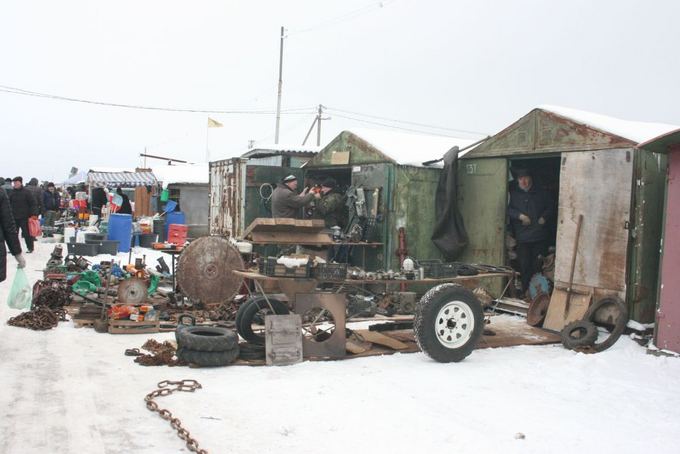 |
| Aurelijos Kripaitės/15min.lt nuotr./Prekybininkai į Rietavą susivežė net garažus. |
As I enter one tent, I get a strong sense of déjà vu. Bright-coloured sweaters lined on hangers remind those that almost everyone used to wear in my primary school two decades ago.
It seems that time has stopped in the curtains section as well. Even the music emanating from loudspeakers sounds like a thing from the past. True, cassette recordings have long been replaced by compact discs.
Life is bustling, though: people are making their way through snow-covered passages between stall rows, enquiring, bargaining. One man decides to try a pair of skis, completely jamming a passage. Another one, his arms above his head, is carrying a baby stroller.
“As the saying goes, one can find everything here, from a nail to a harvester,” says Zigmonas Dirvonskas, director of Rietavas Market which is only open on Sundays. He adds instantly, though: “You can also buy a small log cabin or a sauna.”
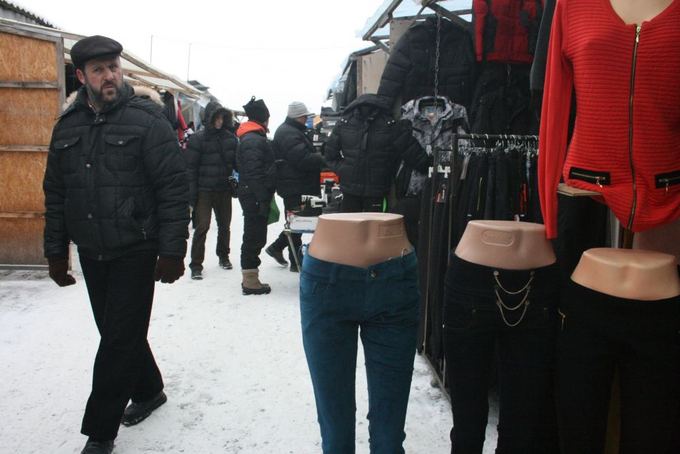 |
| Aurelijos Kripaitės/15min.lt nuotr./Rietavo turguje |
Buyers from Latvia
Arūnas from Gargždai, who has been coming to the market and selling men's underwear and socks every Sunday for the last ten years, is not wearing any gloves – he says he is used to the cold and knows a trick how to keep his hands warm: “Sure, we can take all our merchandise to a tent and sell it from under a roof, but this will only depress the trade. Goods must be visible, laid out so that every passer-by can see them.”
Arūnas works as a bus driver during the rest of the week. He believes that should the marketplace management decide to clean up the place and build brand-new pavilions, Rietavas Market would only lose its charm.
“We don't need anything, things are good as they are. As long as the authorities do not try to strangle us,” he explains. “The rich folk do not come here. Meanwhile our middle class is completely feeble, everyone's running away. I get my best business when Latvians come. That's when I truly make some money.”
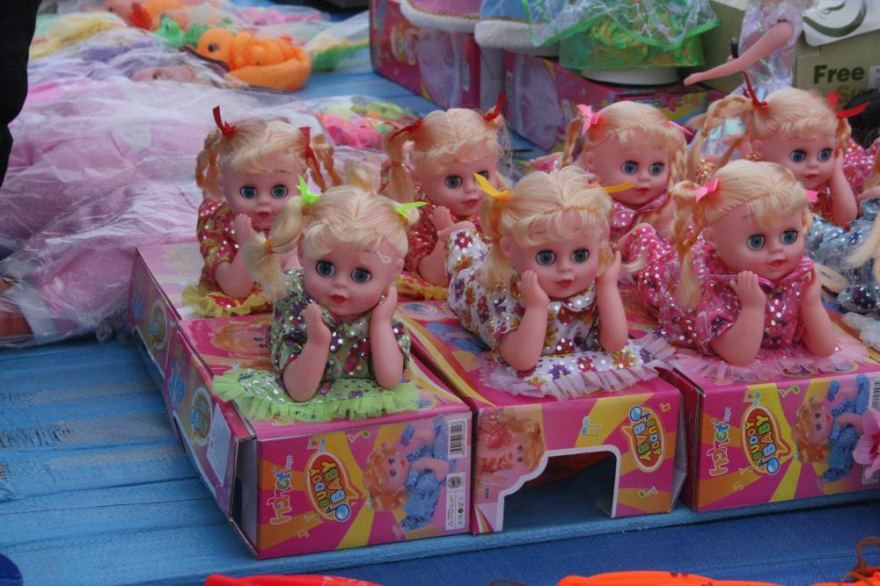 |
| Aurelijos Kripaitės/15min.lt nuotr./Rietavu turguje |
Weekend joys and chores
“Today is a perfect weather for the market – it is cold but dry, so the trade is going well,” glove seller Zita Mockienė says. On weekdays, she works in the market of nearby Šilutė, but every Sunday she loads her goods into a minivan and, together with her son-in-law, comes to Rietavas: “We are doing well, I cannot complain. And the market has grown considerably – even people from Kaunas come to trade here.”
However, all traders agree – working in Rietavas Market alone would not be enough to make a living. Therefore some of them spend weekdays in their local marketplaces, while others drive around small villages, selling their goods from minivans.
“I have a shop in Tauragė, but I must go to the market on Sundays as well. I've been toiling like that for three years, not sure I can bear it much longer,” another trader, Svetlana, confesses.
She notes that some people in the provinces go to the market for weekend entertainment: for the occasion, women dust off their smart coats and wear high-heel shoes, even though it is damp and slippery. There are regulars whom traders see every week.
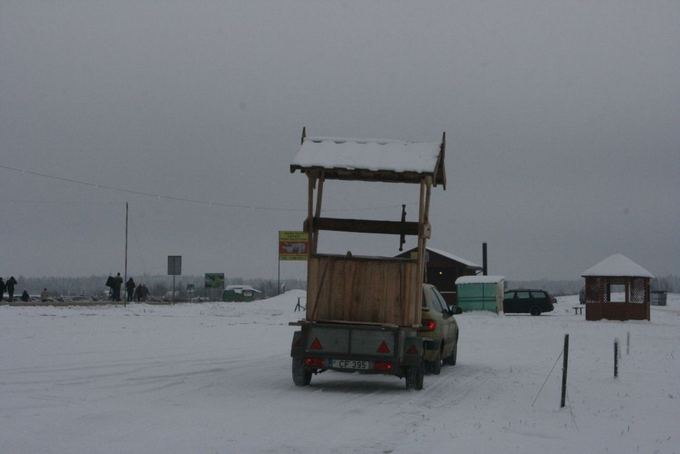 |
| Aurelijos Kripaitės/15min.lt nuotr./Even wells are for sale in Rietavas Market |
Horse-drawn carriage
“Rietavas Market is located in a comfortable site – in the centre of Žemaitija region, in a former airfield, there is room for expansion. There are no big cities around – and no supermarkets to compete with. People from local towns and villages can easily access it, they can buy anything from agricultural machinery to clothing, food, even animals,” Dirvonskas lists the reasons behind the success of Rietavas Market.
He claims that the provinces have preserved the old tradition of Sunday outings to the market – like to a church.
In recent years, however, the market sells significantly fewer cars. On the other hand, trade in second-hand things has blossomed. One can find anything here: souvenirs, second-hand clothes, even antique furniture. “The flee market in Rietavas is expanding, we get customers all the way from Vilnius. They can find some original stuff here,” the market manager says.
He believes that traders are drawn to Rietavas by low rent and the abundance of space – one can put up long stalls. “Many of the pavilions were built by traders themselves. The ones we build are uniform and more elegant. Not everyone is rushing to move into them, but the marketplace will slowly change.”
Dirvonskas has no doubts about the bright future of the market, but he misses a genuine trade in livestock. As things are now, one can buy only cats, domestic birds, dogs, and pigs in Rietavas. “I think the market would be much revived if one could also purchase a horse, a cow, or an ox,” he says.
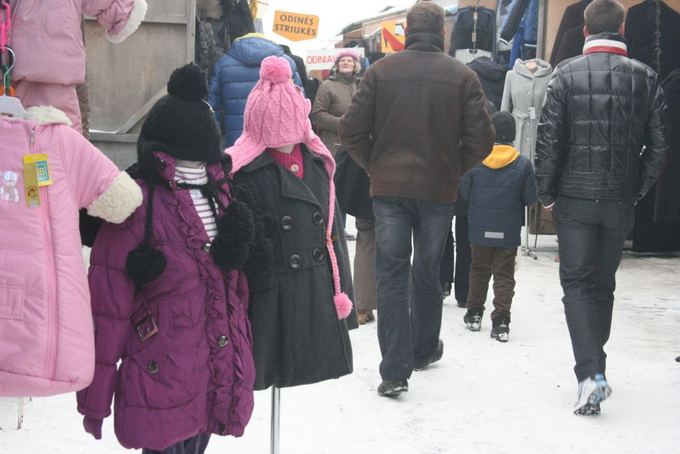 |
| Aurelijos Kripaitės/15min.lt nuotr./Turgavietė gyva jau beveik dvidešimtmetį. |
Undeserved underestimation
The Mayor of Rietavas, Antanas Černeckis, says it is difficult to calculate the exact contribution that the market brings to the municipal coffers: “About thirty people from Rietavas work in the administration of the market. So the municipal budget receives their income tax. It is not much, but the market brings a lot of indirect benefit. Thousands of people visit the town, sometimes they stop to have a snack or drop by in a shop.”
The mayor, who is also a regular visitor at Rietavas Market, recalls that the enterprise was rather chaotic at first. “The market itself was a wild place, it is much more civilized now,” Černeckis says.
Donatas Botyrius, deputy chairman of the Lithuanian Small Businesses and Traders Association, believes that the key factor in the success of Rietavas Market is the fact that there are no major supermarkets in its vicinity. Whereas retail chains – with their heated or air-conditioned spaces, clean rooms, wide variety of products – are pushing out old marketplaces in bigger towns.
“Rietavas Market is located in an excellent spot, quite many farmers come here for whom Sunday is the best day to do some shopping. Besides, everyone knows that they are great buyers,” Botyrius smiles.
Aras Mileška, chairman of Klaipėda Small and Mid-Size Business Council, believes that market traders are undeservedly underrated. There is still a habit in the society to call them spivs.
“The marketplace is the cradle of small business, but there is still little awareness that traders must be supported and encouraged. The best weapon against migration – promotion of small businesses. Only by allowing people to take up their own business, can we hope to keep them here,” Mileška explains.


